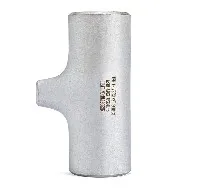
What is the flow capacity of stainless steel pipe tees? Well, if you're in the market for stainless steel pipe tees, you've come to the right place. I'm a supplier of these awesome fittings, and I'm here to break down everything you need to know about their flow capacity.
First off, let's talk about what a stainless steel pipe tee is. It's a fitting that has three openings, allowing the flow of fluid or gas to split or combine. These tees are super popular in a bunch of industries, like plumbing, chemical processing, and food and beverage. And the reason? Stainless steel is tough, resistant to corrosion, and can handle high temperatures and pressures.
Now, the flow capacity of a stainless steel pipe tee depends on a few key factors. One of the most important is the size of the tee. The diameter of the pipes connected to the tee plays a huge role. Generally, the bigger the diameter, the higher the flow capacity. For example, a tee with a 4 - inch diameter will allow more fluid to pass through than a tee with a 2 - inch diameter.
Another factor is the design of the tee. There are different types, like equal tees and reducing tees. Equal tees have all three openings of the same size, while reducing tees have one opening that's a different size from the other two. If you're looking for a specific type, you can check out our Stainless Steel Reducer Tee and 304 Stainless Steel Reducer Tee options.
The material of the stainless steel also matters. Different grades of stainless steel have different properties that can affect flow. For instance, some grades are smoother on the inside, which reduces friction and allows the fluid to flow more easily. This means a higher flow capacity.
The shape of the tee's interior is crucial too. A well - designed tee will have a smooth transition where the pipes meet. This reduces turbulence in the fluid flow. Turbulence can slow down the flow and decrease the overall flow capacity. If you want to explore a wide range of options, take a look at our Stainless Steel Tee Fittings.
Let's get a bit technical here. The flow capacity of a pipe tee can be calculated using some engineering formulas. One common way is to use the Darcy - Weisbach equation, which takes into account factors like the pipe diameter, length, friction factor, and the velocity of the fluid. But don't worry if you're not an engineer. We've got experts on our team who can help you figure out the right tee for your specific flow requirements.
In real - world applications, the flow capacity of a stainless steel pipe tee can vary. For example, in a plumbing system, the flow might be affected by the water pressure in the building. In a chemical processing plant, the viscosity of the chemicals being transported can have a big impact.
If you're using a tee in a high - pressure system, you need to make sure it can handle the pressure without leaking or failing. Stainless steel is great for high - pressure applications because it's strong and durable. But you still need to choose the right size and grade of tee.
When it comes to installation, it's really important to do it right. A poorly installed tee can cause all sorts of problems, like leaks and reduced flow capacity. Make sure the pipes are properly aligned and that the tee is tightened correctly.
We've seen a lot of different projects where our stainless steel pipe tees have been used. In a recent food processing project, the customer needed a tee that could handle a high - volume flow of liquid ingredients. We recommended an equal tee with a large diameter, and it worked like a charm. The customer was really happy with the flow capacity and the durability of the tee.
In another case, a chemical plant needed a reducing tee for a specific process. They were worried about the flow capacity and the chemical resistance of the tee. We provided them with a 304 Stainless Steel Reducer Tee that met all their requirements. The tee was able to handle the chemical flow without any issues.
So, if you're in the market for stainless steel pipe tees, and you're wondering about the flow capacity, don't hesitate to reach out. We've got a wide range of options, and our team of experts can help you choose the right tee for your project. Whether you need a small tee for a home plumbing job or a large tee for an industrial application, we've got you covered.
If you're ready to start your project or just want to learn more, feel free to get in touch. We're here to answer all your questions and help you make the best decision for your flow needs.


References
- Fluid Mechanics textbooks for Darcy - Weisbach equation details
- Industry standards for stainless steel pipe tee design and performance