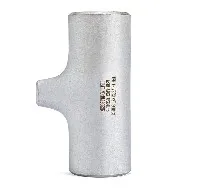
As a seasoned supplier of butt weld tees, I've witnessed firsthand the critical importance of understanding the marking requirements for these essential pipe fittings. In this blog post, I'll delve into the details of what these marking requirements entail, why they are crucial, and how they impact the quality and safety of butt weld tees.
The Significance of Marking Butt Weld Tees
Marking butt weld tees is not just a matter of aesthetics or compliance; it serves several vital functions. Firstly, clear and accurate markings provide essential information about the tee, such as its size, material, and manufacturing standards. This information is crucial for installers, inspectors, and end-users to ensure that the tee is suitable for the intended application and meets the required specifications.
Secondly, markings help in traceability. In the event of a quality issue or a need for maintenance, the markings on the tee can be used to identify its origin, manufacturing date, and other relevant details. This traceability is essential for quality control, warranty claims, and regulatory compliance.
Finally, proper markings enhance safety. By clearly indicating the pressure rating, temperature limits, and other important parameters, the markings help users to install and operate the tee safely. This reduces the risk of accidents, leaks, and other safety hazards.

Key Marking Requirements
Size and Dimensions
The size and dimensions of the butt weld tee are perhaps the most critical information to be marked. This includes the nominal pipe size (NPS) or diameter of the main run and the branch, as well as the wall thickness. The markings should follow the standard sizing conventions, such as those defined by the American National Standards Institute (ANSI) or the International Organization for Standardization (ISO).
For example, a butt weld tee with a main run of NPS 4 and a branch of NPS 2 would be marked as "4 x 2". The wall thickness may also be indicated, such as "SCH 40" for standard schedule 40 pipe.
Material
The material of the butt weld tee is another important piece of information to be marked. This helps to ensure that the tee is compatible with the fluid or gas being transported and can withstand the operating conditions. Common materials for butt weld tees include carbon steel, stainless steel, alloy steel, and duplex stainless steel.
The markings should indicate the specific material grade, such as "ASTM A105" for carbon steel or "ASTM A312 TP304" for stainless steel. This information is crucial for proper material selection and quality control.

Manufacturing Standard
The manufacturing standard to which the butt weld tee is produced should also be marked. This provides assurance that the tee has been manufactured to a recognized set of quality and performance requirements. Common manufacturing standards for butt weld tees include ANSI B16.9, ASME B16.9, and MSS SP-75.
The markings should indicate the specific standard number, such as "ANSI B16.9" or "ASME B16.9". This helps to ensure that the tee meets the required dimensions, tolerances, and quality criteria.
Pressure Rating
The pressure rating of the butt weld tee is an important safety parameter that should be marked. This indicates the maximum pressure that the tee can safely withstand under normal operating conditions. The pressure rating is typically expressed in pounds per square inch (psi) or megapascals (MPa).
The markings should indicate the specific pressure rating, such as "150 psi" or "1.0 MPa". This information is crucial for proper installation and operation of the tee, as it helps to ensure that the tee is not subjected to pressures that exceed its design limits.
Heat Number
The heat number is a unique identifier assigned to a batch of steel during the manufacturing process. It provides traceability to the specific heat of steel from which the tee was made. The heat number is important for quality control and for identifying the source of any potential quality issues.
The markings should indicate the heat number, which is typically a combination of letters and numbers. This information can be used to track the manufacturing history of the tee and to ensure that it meets the required quality standards.
Marking Methods
There are several methods that can be used to mark butt weld tees, each with its own advantages and disadvantages. The choice of marking method depends on factors such as the material of the tee, the size and shape of the tee, and the required durability of the markings.
Stamping
Stamping is a common method of marking butt weld tees. It involves using a die to imprint the markings onto the surface of the tee. Stamping provides clear and permanent markings that are resistant to wear and corrosion. However, it can be limited in terms of the size and complexity of the markings that can be made.
Engraving
Engraving is another method of marking butt weld tees. It involves using a laser or a mechanical tool to cut the markings into the surface of the tee. Engraving provides high-quality, detailed markings that are suitable for complex designs and small sizes. However, it can be more expensive and time-consuming than stamping.
Etching
Etching is a chemical process that involves using an acid or other chemical to remove a thin layer of material from the surface of the tee, creating the markings. Etching provides clear and precise markings that are suitable for a variety of materials. However, it can be more environmentally hazardous than stamping or engraving.
Paint Marking
Paint marking is a simple and cost-effective method of marking butt weld tees. It involves using a paint or ink to apply the markings onto the surface of the tee. Paint marking is suitable for temporary or less permanent markings, but it may not be as durable as stamping, engraving, or etching.
Compliance with Standards and Regulations
In addition to the specific marking requirements outlined above, butt weld tees must also comply with various standards and regulations. These standards and regulations are designed to ensure the safety, quality, and performance of the tees.
International Standards
There are several international standards that govern the marking requirements for butt weld tees. These include ISO 9001 for quality management systems, ISO 14001 for environmental management systems, and ISO 45001 for occupational health and safety management systems.

Compliance with these standards demonstrates a commitment to quality, environmental responsibility, and safety. It also helps to ensure that the tees are manufactured and marked in a consistent and reliable manner.
National and Regional Regulations
In addition to international standards, butt weld tees must also comply with national and regional regulations. These regulations may vary depending on the country or region in which the tees are used.

For example, in the United States, butt weld tees must comply with the requirements of the American Society of Mechanical Engineers (ASME) Boiler and Pressure Vessel Code. This code sets out the design, fabrication, and inspection requirements for pressure vessels and piping systems, including butt weld tees.
Conclusion
In conclusion, understanding the marking requirements for butt weld tees is essential for ensuring their quality, safety, and performance. Clear and accurate markings provide important information about the tee, such as its size, material, manufacturing standard, pressure rating, and heat number. This information is crucial for installers, inspectors, and end-users to ensure that the tee is suitable for the intended application and meets the required specifications.
As a supplier of butt weld tees, we are committed to providing high-quality products that meet or exceed the marking requirements and industry standards. Our Stainless Steel Tee, Stainless Steel Tee Fittings, and Stainless Steel Reducer Tee are carefully marked to provide all the necessary information for proper installation and operation.
If you are in the market for butt weld tees or have any questions about our products, please do not hesitate to contact us. We would be happy to discuss your requirements and provide you with a quote. Our team of experts is always available to assist you with your piping needs.
References
- ANSI B16.9 - Factory-Made Wrought Buttwelding Fittings
- ASME B16.9 - Factory-Made Wrought Buttwelding Fittings
- MSS SP-75 - High Test Wrought Buttwelding Fittings
- ASTM A105 - Standard Specification for Carbon Steel Forgings for Piping Applications
- ASTM A312 - Standard Specification for Seamless, Welded, and Heavily Cold Worked Austenitic Stainless Steel Pipes