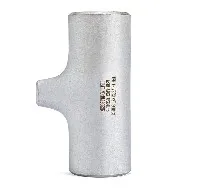
When it comes to understanding the mechanical properties of butt weld tees, one crucial aspect that often gets overlooked is the coefficient of friction. As a supplier of butt weld tees, I've encountered numerous inquiries regarding this topic, and I believe it's essential to shed light on what the coefficient of friction of a butt weld tee truly means and why it matters.
Understanding the Coefficient of Friction
The coefficient of friction is a dimensionless quantity that represents the ratio of the force of friction between two surfaces to the normal force pressing the two surfaces together. In the context of a butt weld tee, this coefficient is significant because it affects how the tee interacts with other components in a piping system.
There are two main types of coefficients of friction: static and kinetic. The static coefficient of friction (μs) is the value when the two surfaces are at rest relative to each other. It determines the minimum force required to initiate motion between the surfaces. On the other hand, the kinetic coefficient of friction (μk) comes into play when the surfaces are in relative motion. Typically, μs is greater than μk, meaning it takes more force to start moving an object than to keep it moving.
Factors Affecting the Coefficient of Friction in Butt Weld Tees
Several factors can influence the coefficient of friction of a butt weld tee. Material composition is one of the most critical factors. Different materials have different surface characteristics that affect how they interact with other surfaces. For example, a stainless - steel butt weld tee will have a different coefficient of friction compared to a carbon - steel tee. Stainless steel is known for its smooth surface finish, which generally results in a lower coefficient of friction compared to carbon steel, which may have a rougher surface due to oxidation or surface treatments.
Surface finish also plays a vital role. A polished surface on a butt weld tee will have a lower coefficient of friction than a rough - finished one. During the manufacturing process, the tee can be subjected to various finishing operations such as grinding, sanding, or polishing. These operations can significantly alter the surface texture and, consequently, the coefficient of friction.
The presence of contaminants or lubricants can also have a profound impact on the coefficient of friction. If there are dirt, dust, or other particles between the surfaces of the butt weld tee and the mating component, the coefficient of friction can increase. Conversely, the application of a lubricant can reduce the friction, making it easier for the tee to move or adjust within the piping system.
Measuring the Coefficient of Friction
Measuring the coefficient of friction of a butt weld tee is not a straightforward process. Specialized equipment is required to accurately determine both the static and kinetic coefficients of friction. One common method is the inclined - plane method. In this method, the butt weld tee is placed on an inclined plane, and the angle of the plane is gradually increased until the tee starts to slide. The tangent of this angle at the point of incipient motion gives the static coefficient of friction.
Another method involves using a friction testing machine. This machine applies a known normal force to the tee and measures the frictional force as the tee is either stationary or in motion. By dividing the frictional force by the normal force, the coefficient of friction can be calculated.
Importance of the Coefficient of Friction in Piping Systems
The coefficient of friction of a butt weld tee has several implications in piping systems. In terms of installation, a lower coefficient of friction can make it easier to assemble the tee into the system. Workers can more easily slide the tee into place, reducing the amount of force required and potentially minimizing the risk of damage to the tee or other components.
During operation, the coefficient of friction affects the flow of fluids within the piping system. If the friction between the fluid and the inner surface of the tee is high, it can lead to increased pressure drop. This increased pressure drop can result in higher energy consumption as pumps need to work harder to maintain the desired flow rate.
In seismic or vibration - prone areas, the coefficient of friction can influence the stability of the piping system. A higher coefficient of friction can help prevent the tee from moving or shifting during an earthquake or other vibrations, ensuring the integrity of the entire system.
Our Offerings as a Butt Weld Tee Supplier
As a supplier of butt weld tees, we understand the importance of the coefficient of friction and its impact on the performance of piping systems. We offer a wide range of butt weld tees made from different materials, including 304 Stainless Steel Reducer Tee and other Stainless Steel Reducer Tee options.
We pay close attention to the manufacturing process to ensure that our tees have the appropriate surface finish. Our quality control measures include rigorous testing to determine the coefficient of friction of our products. This allows us to provide our customers with tees that meet their specific requirements in terms of friction characteristics.


Whether you need a tee with a low coefficient of friction for easy installation or a higher coefficient for enhanced stability, we can work with you to find the right solution. Our team of experts is always available to answer any questions you may have about the coefficient of friction or any other aspect of our butt weld tees.
Contact Us for Procurement
If you're in the market for high - quality butt weld tees and want to discuss the coefficient of friction or other technical details, we encourage you to reach out to us. We're here to help you make the best choice for your piping system. Whether you're involved in a small - scale project or a large - scale industrial application, we have the products and expertise to meet your needs.
References
- Bowden, F. P., & Tabor, D. (1950). Friction and Lubrication of Solids. Oxford University Press.
- Holman, J. P. (2009). Heat Transfer. McGraw - Hill.
- Incropera, F. P., & DeWitt, D. P. (2002). Fundamentals of Heat and Mass Transfer. Wiley.