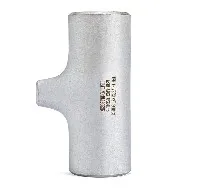
As a supplier of butt weld reducer tees, I've witnessed firsthand the importance of high - quality welding in the manufacturing process. Butt weld reducer tees are crucial components in various piping systems, used to connect pipes of different diameters and directions. However, welding defects can significantly compromise the integrity and performance of these tees. In this blog, I'll discuss some of the common welding defects in butt weld reducer tees.
Porosity
Porosity is one of the most frequently encountered welding defects. It appears as small holes or cavities within the weld metal. This defect occurs when gas is trapped during the solidification of the weld pool. There are several reasons for porosity. Firstly, improper shielding gas can be a culprit. If the shielding gas is not flowing at the correct rate or if there are leaks in the gas delivery system, the weld pool will not be adequately protected from the surrounding atmosphere. Oxygen, nitrogen, and hydrogen from the air can then dissolve into the molten metal and form bubbles as it cools.
Secondly, contaminants on the base metal or filler material can also lead to porosity. Rust, oil, grease, or paint on the surfaces to be welded can release gases when heated, which get trapped in the weld. As a supplier, we always ensure that the base metals and filler materials are thoroughly cleaned before welding. We also regularly check the shielding gas equipment to maintain the proper flow rate. For more information on high - quality tees like Stainless Steel Tee Fittings, our website provides detailed product specifications.
Lack of Fusion
Lack of fusion refers to the failure of the weld metal to fuse completely with the base metal or with previous weld passes. This can happen when the welding heat is insufficient to melt the base metal properly. Welding too fast, using a low welding current, or incorrect electrode angle can all contribute to this defect. When there is a lack of fusion, the joint strength is severely reduced, and it becomes more susceptible to cracking under stress.
In our manufacturing process, we carefully control the welding parameters. Our welders are highly trained to adjust the welding speed, current, and electrode angle according to the specific requirements of each butt weld reducer tee. We also conduct regular inspections to detect any signs of lack of fusion. Products such as Stainless Steel Tee in our catalog are manufactured with strict quality control to avoid this defect.
Cracking
Cracking is a serious welding defect that can lead to catastrophic failure of the butt weld reducer tee. There are two main types of cracking: hot cracking and cold cracking.
Hot cracking occurs during the solidification of the weld metal. It is often caused by the presence of impurities such as sulfur and phosphorus in the weld metal, as well as high residual stresses. These impurities can form low - melting - point compounds that weaken the grain boundaries of the weld metal, making it more prone to cracking. To prevent hot cracking, we use high - quality filler materials with low impurity content and adopt proper welding techniques to reduce residual stresses.
Cold cracking, on the other hand, occurs after the weld has cooled. It is mainly due to the presence of hydrogen in the weld metal, high residual stresses, and hard microstructures. Hydrogen can be introduced during welding from moisture in the electrode coating, shielding gas, or on the base metal surface. We take measures to control the hydrogen content, such as baking the electrodes before use and ensuring a dry welding environment. Our 304 Stainless Steel Reducer Tee is manufactured with advanced techniques to minimize the risk of cracking.
Incomplete Penetration
Incomplete penetration means that the weld does not penetrate through the entire thickness of the joint. This can occur when the welding current is too low, the groove preparation is incorrect, or the root gap is too small. Incomplete penetration reduces the cross - sectional area of the weld, which in turn weakens the joint. To ensure complete penetration, we carefully prepare the joint grooves and select the appropriate welding parameters. Our quality control team checks the penetration depth of each weld to guarantee the strength of the butt weld reducer tee.
Slag Inclusions
Slag inclusions are non - metallic particles that are trapped within the weld metal. Slag is a by - product of the welding process, and it is supposed to float to the surface of the weld pool and be removed. However, if the welding technique is incorrect, such as improper electrode manipulation or insufficient cleaning between weld passes, the slag can get trapped in the weld. Slag inclusions can reduce the ductility and toughness of the weld, and they can also act as stress raisers, increasing the likelihood of cracking.
In our production, our welders are trained to use proper electrode manipulation techniques to ensure that the slag floats to the surface. We also clean the weld surface thoroughly between each pass to prevent slag inclusions.


Undercutting
Undercutting is a groove or depression formed at the toe of the weld, along the base metal. It is caused by excessive heat input, high welding speed, or incorrect electrode angle. Undercutting reduces the cross - sectional area of the base metal, which weakens the joint. It can also act as a stress concentration point, leading to cracking.
To avoid undercutting, we carefully control the welding parameters. Our experienced welders adjust the heat input, welding speed, and electrode angle to ensure a smooth and uniform weld without undercutting.
In conclusion, as a supplier of butt weld reducer tees, we are well - aware of the common welding defects and take every measure to prevent them. We use high - quality materials, advanced welding techniques, and strict quality control processes to ensure that our products meet the highest standards. If you are in need of high - quality butt weld reducer tees or have any questions about our products, we encourage you to contact us for procurement discussions. We are committed to providing you with the best products and services.
References
- Welding Handbook, American Welding Society
- Piping Design and Engineering, Cameron Engineering and Associates