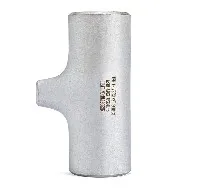
As a supplier of butt weld reducer tees, I often get asked about how to calculate the weight of these fittings. It's an important question, especially for those in construction, plumbing, and other industries where precise measurements and cost estimates are crucial. In this blog post, I'll break down the process for calculating the weight of a butt weld reducer tee, and explain why it's so important.


Understanding the Basics of Butt Weld Reducer Tees
Before we dive into the calculations, let's quickly review what a butt weld reducer tee is. A butt weld reducer tee is a type of pipe fitting that is used to connect three pipes of different sizes. The main body of the tee is typically larger than the branch, and the transition between the two sizes is smooth, which helps to minimize turbulence and pressure drop in the fluid or gas flowing through the pipes.
Butt weld reducer tees are commonly made from a variety of materials, including carbon steel, stainless steel, and alloy steel. Stainless Steel Reducer Tee is a popular choice because of its corrosion resistance and durability. You can also find Stainless Steel Tee and 304 Stainless Steel Reducer Tee options, which are known for their high quality and performance.
Why Calculating the Weight Matters
Calculating the weight of a butt weld reducer tee is important for several reasons. First, it helps you determine the shipping cost. Heavier fittings will cost more to ship, so knowing the weight upfront can help you budget for this expense. Second, it's essential for structural calculations. If you're using the reducer tee in a construction project, you need to know its weight to ensure that the supporting structure can handle the load. Finally, it can help you estimate the cost of the material. Since most materials are sold by weight, knowing the weight of the fitting allows you to calculate the cost accurately.
The Formula for Calculating the Weight of a Butt Weld Reducer Tee
Calculating the weight of a butt weld reducer tee involves a few steps, but it's not as complicated as it might seem. The general formula for calculating the weight of a pipe fitting is:
[ W = 0.02466 \times S \times (D - S) \times L \times \rho ]
Where:
- ( W ) is the weight of the fitting in kilograms
- ( S ) is the wall thickness of the pipe in millimeters
- ( D ) is the outer diameter of the pipe in millimeters
- ( L ) is the length of the fitting in millimeters
- ( \rho ) is the density of the material in grams per cubic centimeter
For a butt weld reducer tee, you'll need to calculate the weight of the main body and the branch separately, and then add them together. Here's a step-by-step guide:
Step 1: Measure the Dimensions
You'll need to measure the outer diameter (( D )), wall thickness (( S )), and length (( L )) of both the main body and the branch of the reducer tee. Make sure to use the same units (millimeters) for all measurements.
Step 2: Determine the Density of the Material
The density of the material can vary depending on the type of metal used. Here are some common densities for different materials:
- Carbon steel: ( \rho = 7.85 , g/cm^3 )
- Stainless steel: ( \rho = 7.93 , g/cm^3 )
- Alloy steel: ( \rho ) can vary, but is typically around ( 7.8 - 8.0 , g/cm^3 )
Step 3: Calculate the Weight of the Main Body
Use the formula above to calculate the weight of the main body of the reducer tee. Plug in the values for ( D ), ( S ), ( L ), and ( \rho ) for the main body.
Step 4: Calculate the Weight of the Branch
Repeat the process for the branch of the reducer tee. Use the appropriate values for ( D ), ( S ), ( L ), and ( \rho ) for the branch.
Step 5: Add the Weights Together
Once you have calculated the weight of the main body and the branch, add them together to get the total weight of the butt weld reducer tee.
An Example Calculation
Let's say we have a 304 Stainless Steel Reducer Tee with the following dimensions:
- Main body: ( D_1 = 100 , mm ), ( S_1 = 5 , mm ), ( L_1 = 200 , mm )
- Branch: ( D_2 = 80 , mm ), ( S_2 = 4 , mm ), ( L_2 = 150 , mm )
The density of 304 stainless steel is ( \rho = 7.93 , g/cm^3 ).
First, let's calculate the weight of the main body:
[ W_1 = 0.02466 \times S_1 \times (D_1 - S_1) \times L_1 \times \frac{\rho}{1000} ]
[ W_1 = 0.02466 \times 5 \times (100 - 5) \times 200 \times \frac{7.93}{1000} ]
[ W_1 = 0.02466 \times 5 \times 95 \times 200 \times 0.00793 ]
[ W_1 \approx 18.42 , kg ]
Next, let's calculate the weight of the branch:
[ W_2 = 0.02466 \times S_2 \times (D_2 - S_2) \times L_2 \times \frac{\rho}{1000} ]
[ W_2 = 0.02466 \times 4 \times (80 - 4) \times 150 \times \frac{7.93}{1000} ]
[ W_2 = 0.02466 \times 4 \times 76 \times 150 \times 0.00793 ]
[ W_2 \approx 7.02 , kg ]
Finally, let's add the weights together to get the total weight of the reducer tee:
[ W = W_1 + W_2 ]
[ W = 18.42 + 7.02 ]
[ W \approx 25.44 , kg ]
Factors That Can Affect the Weight
It's important to note that the actual weight of a butt weld reducer tee may vary slightly from the calculated weight. This can be due to several factors, including:
- Manufacturing tolerances: The actual dimensions of the fitting may deviate slightly from the specified dimensions.
- Surface finish: A rough surface finish can add a small amount of weight.
- Material impurities: Impurities in the material can affect its density.
Conclusion
Calculating the weight of a butt weld reducer tee is a straightforward process that involves measuring the dimensions, determining the density of the material, and using a simple formula. By knowing the weight of the fitting, you can accurately estimate the shipping cost, ensure the structural integrity of your project, and calculate the cost of the material.
If you're in the market for high-quality butt weld reducer tees, we're here to help. We offer a wide range of Stainless Steel Reducer Tee, Stainless Steel Tee, and 304 Stainless Steel Reducer Tee options to meet your specific needs. Contact us today to discuss your requirements and get a quote.
References
- "Pipe Fittings Handbook"
- "Materials Science and Engineering: An Introduction"