What is the Poisson's ratio of ss pipe fittings?
As a supplier of high - quality ss (stainless steel) pipe fittings, I often encounter various technical inquiries from clients. One question that comes up more frequently than one might expect is about the Poisson's ratio of ss pipe fittings. In this blog post, I'll dive deep into what the Poisson's ratio is, its significance for ss pipe fittings, and how it impacts the performance and applications of these essential components.
Understanding Poisson's Ratio
Poisson's ratio, denoted by the Greek letter ν (nu), is a fundamental mechanical property of materials. It describes the relationship between the lateral strain and the longitudinal strain when a material is subjected to uniaxial loading. When a material is stretched or compressed in one direction (longitudinal direction), it will also deform in the perpendicular (lateral) directions. Poisson's ratio is defined as the negative ratio of the lateral strain (ε_lateral) to the longitudinal strain (ε_longitudinal):
ν = - ε_lateral / ε_longitudinal
For most engineering materials, Poisson's ratio ranges between 0 and 0.5. A value of 0 would imply that the material does not deform laterally when loaded longitudinally, while a value of 0.5 indicates that the volume of the material remains constant during deformation.
Poisson's Ratio of Stainless Steel
Stainless steel, the primary material for ss pipe fittings, typically has a Poisson's ratio in the range of 0.25 - 0.3. The exact value can vary depending on the specific grade of stainless steel, its microstructure, and any heat treatments or processing it has undergone.
For example, common austenitic stainless steels like 304 and 316 have Poisson's ratios close to 0.3. This value is important because it affects how the stainless steel will respond to different types of mechanical loads. When a stainless steel pipe fitting is under tension, it will contract laterally, and when under compression, it will expand laterally according to its Poisson's ratio.
Significance for SS Pipe Fittings
Structural Integrity
The Poisson's ratio plays a crucial role in maintaining the structural integrity of ss pipe fittings. In piping systems, these fittings are often subjected to internal pressure, external forces, and thermal stresses. Understanding the Poisson's ratio helps in accurately predicting how the fittings will deform under these loads. For instance, when a pipe is pressurized, the internal pressure causes the pipe to expand both longitudinally and laterally. The Poisson's ratio determines the relationship between these two types of expansion. If the lateral expansion is not properly accounted for, it can lead to excessive stress concentrations at the fittings, potentially causing leaks or even failure of the entire piping system.
Design and Installation
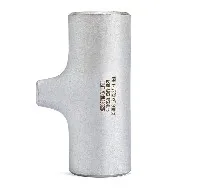
Engineers and designers rely on the Poisson's ratio when designing ss pipe fittings. They use this property to calculate the appropriate dimensions, wall thickness, and reinforcement requirements for the fittings. For example, in the design of a Stainless Steel Tee, the Poisson's ratio is considered to ensure that the tee can withstand the forces acting on it without deforming beyond acceptable limits. During installation, knowledge of the Poisson's ratio helps in determining the proper clamping and support methods to prevent over - stressing of the fittings.
Compatibility with Other Materials
In many piping systems, ss pipe fittings are used in conjunction with other materials such as gaskets, flanges, and valves. The Poisson's ratio of stainless steel affects how it interacts with these other materials. If the Poisson's ratio of the stainless steel fitting is significantly different from that of the adjacent components, it can lead to differential deformation and potential leakage at the joints. Therefore, considering the Poisson's ratio is essential for ensuring a proper and long - lasting connection between different parts of the piping system.
Impact on Performance and Applications
High - Pressure Applications
In high - pressure piping systems, such as those used in oil and gas, chemical processing, and power generation, the Poisson's ratio of ss pipe fittings is of utmost importance. The high internal pressures can cause significant deformation of the fittings, and the Poisson's ratio helps in designing fittings that can withstand these pressures without failure. For example, 316 Stainless Steel Pipe Tee used in high - pressure seawater desalination plants need to be designed with the correct Poisson's ratio in mind to ensure reliable operation.
Thermal Expansion and Contraction
Thermal cycling is another factor that affects ss pipe fittings. As the temperature changes, the stainless steel will expand or contract. The Poisson's ratio determines how this expansion or contraction will occur in both the longitudinal and lateral directions. In applications where there are significant temperature variations, such as in industrial furnaces or cryogenic systems, understanding the Poisson's ratio is crucial for preventing thermal stresses from causing damage to the pipe fittings.
Resistance to Fatigue
The Poisson's ratio also influences the fatigue resistance of ss pipe fittings. Fatigue failure can occur when the fittings are subjected to repeated loading and unloading cycles. The lateral deformation caused by the Poisson's ratio during these cycles can contribute to the initiation and propagation of cracks. By considering the Poisson's ratio in the design and material selection, the fatigue life of the pipe fittings can be extended.
Applications of SS Pipe Fittings and Poisson's Ratio
Plumbing Systems
In residential and commercial plumbing systems, ss pipe fittings are used to connect pipes and direct the flow of water. Although the pressures in these systems are relatively low compared to industrial applications, the Poisson's ratio still affects the long - term performance of the fittings. It helps in ensuring that the fittings can withstand the normal wear and tear, as well as any minor pressure fluctuations in the plumbing network.


Industrial Piping
In industrial settings, ss pipe fittings are used in a wide range of applications, from transporting chemicals to carrying steam. The Poisson's ratio is considered in the design of complex piping layouts, where the fittings need to handle different types of loads and stresses. For example, Stainless Steel Reducer Tee used in chemical plants need to be carefully designed to account for the Poisson's ratio to prevent corrosion and leakage due to stress concentrations.
Conclusion
In conclusion, the Poisson's ratio of ss pipe fittings is a critical mechanical property that affects their structural integrity, design, installation, and performance. As a supplier of ss pipe fittings, I understand the importance of this property and ensure that our products are designed and manufactured with the appropriate consideration for the Poisson's ratio of stainless steel.
If you are in need of high - quality ss pipe fittings for your project, whether it's a small plumbing job or a large - scale industrial application, I encourage you to reach out. Our team of experts can provide you with detailed information about the Poisson's ratio and other technical aspects of our products to ensure that you make the best choice for your specific needs. Contact us to start a procurement discussion and find the perfect ss pipe fittings for your requirements.
References
- Callister, W. D., & Rethwisch, D. G. (2017). Materials Science and Engineering: An Introduction. Wiley.
- ASME Boiler and Pressure Vessel Code, Section VIII, Division 1. American Society of Mechanical Engineers.
- ISO 15590 - 1:2015, Plastics pipes and fittings - Determination of the Poisson's ratio. International Organization for Standardization.