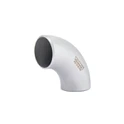
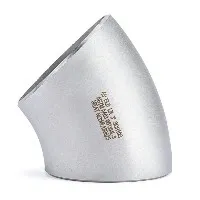
Hey there! As a supplier of Stainless Steel Stub Ends, I often get asked about the manufacturing processes behind these nifty little components. So, I thought I'd take a moment to break it down for you.
Starting with the Raw Materials
First things first, we need to talk about the raw materials. Stainless steel is an alloy, which means it's made up of a bunch of different elements. The main ingredient is iron, but we also throw in chromium, nickel, and a few other things to give it that corrosion - resistant and tough quality.
The type of stainless steel we use depends on the application of the stub ends. For general - purpose use, we might go with 304 stainless steel. It's got good corrosion resistance and is relatively easy to work with. If the stub ends are going to be used in more corrosive environments, like in chemical plants or near the ocean, we'd opt for 316 stainless steel. It has a higher molybdenum content, which gives it better resistance to pitting and crevice corrosion.
Melting and Casting
Once we've selected the right type of stainless steel, the next step is melting. We put the raw materials into a furnace, and it gets heated up to super - high temperatures, usually around 1,500 - 1,600 degrees Celsius. This melts all the elements together, creating a homogenous liquid.
After the steel is melted, we can either cast it into ingots or use continuous casting methods. Casting into ingots is like pouring the molten steel into big molds. These ingots are then further processed to make billets or blooms, which are the starting shapes for making stub ends. Continuous casting, on the other hand, is a more efficient process where the molten steel is continuously poured through a water - cooled mold, forming a long, solid piece that can be cut into the desired lengths.
Forming the Stub Ends
There are a few different ways to form the stainless steel into stub ends. One common method is hot forging. In hot forging, we heat the billet or bloom to a high temperature (usually around 1,100 - 1,200 degrees Celsius) and then use a forging press to shape it. The press applies a lot of force to the heated steel, squeezing it into the shape of a stub end. This process not only gives the stub end its basic shape but also improves its mechanical properties by aligning the grain structure of the steel.
Another method is cold forming. Cold forming is done at room temperature or slightly elevated temperatures. We use machines like presses and rollers to bend and shape the stainless steel. Cold forming is great for making more precise shapes and can be used for smaller - sized stub ends. It also doesn't require as much energy as hot forging, which is a plus.


Machining
After the initial forming, the stub ends usually need some machining. Machining is the process of removing excess material to get the exact dimensions and surface finish we want. We use a variety of machining tools, such as lathes, milling machines, and drills.
On a lathe, we can turn the stub end to make it round and smooth. We can also cut threads on the ends if the stub ends are going to be connected to other pipes using threaded connections. Milling machines are used to create flat surfaces or to cut grooves and slots. Drills are used to make holes, which might be needed for things like mounting or for passing through bolts.
Heat Treatment
Heat treatment is an important step in the manufacturing process of stainless steel stub ends. It helps to improve the mechanical properties of the steel, such as its hardness, strength, and toughness. There are different types of heat treatments we can use.
One common heat treatment is annealing. Annealing involves heating the stub ends to a specific temperature (usually around 1,000 - 1,100 degrees Celsius) and then slowly cooling them. This process relieves internal stresses in the steel and makes it more ductile, which means it can be bent or stretched without breaking.
Another heat treatment is quenching and tempering. Quenching is when we heat the steel to a high temperature and then rapidly cool it by immersing it in a liquid, like oil or water. This makes the steel very hard. However, it also makes it brittle. So, we follow up with tempering, which involves heating the quenched steel to a lower temperature and then cooling it slowly. This reduces the brittleness and gives the steel a good balance of hardness and toughness.
Surface Finishing
The surface finish of the stainless steel stub ends is not just about looks; it also affects their performance. A smooth surface finish can reduce friction and make it easier to connect the stub ends to other pipes. It can also improve the corrosion resistance of the steel.
We can achieve different surface finishes through various methods. One common method is grinding. Grinding uses abrasive wheels to remove small amounts of material from the surface of the stub end, making it smooth. We can also use polishing to get an even shinier and smoother surface. Polishing involves using finer abrasives and a buffing wheel to create a mirror - like finish.
Quality Control
Throughout the manufacturing process, we have strict quality control measures in place. We use a variety of testing methods to ensure that the stub ends meet the required standards.
One important test is the non - destructive testing (NDT). NDT methods, such as ultrasonic testing and magnetic particle testing, are used to detect any internal or surface defects in the stainless steel. Ultrasonic testing uses high - frequency sound waves to detect flaws inside the steel, while magnetic particle testing is used to find surface and near - surface defects in ferromagnetic stainless steels.
We also do mechanical testing, such as tensile testing and hardness testing. Tensile testing measures the strength of the stub end by pulling it until it breaks. Hardness testing measures how hard the steel is, which can give us an idea of its wear resistance and other mechanical properties.
Applications and Related Products
Stainless steel stub ends are used in a wide range of industries, including oil and gas, chemical processing, and food and beverage. They are often used in piping systems to connect pipes or to change the direction of the flow.
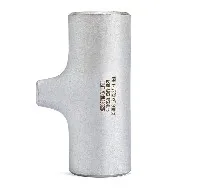
If you're interested in other stainless - steel pipe fittings, we also offer 304 Stainless Steel Reducer Tee 304 Stainless Steel Reducer Tee, Stainless Steel Tee Fittings Stainless Steel Tee Fittings, and 316 Stainless Steel Pipe Tee 316 Stainless Steel Pipe Tee. These products are also manufactured with the same high - quality standards as our stub ends.
Wrapping Up and Connecting
Well, that's a rundown of the manufacturing processes of stainless steel stub ends. As a supplier, we're committed to providing high - quality products that meet your needs. Whether you're working on a small - scale project or a large - scale industrial application, we've got the right stub ends for you.
If you're interested in purchasing stainless steel stub ends or any of our other products, don't hesitate to reach out. We're here to answer your questions and help you find the best solutions for your piping systems. Let's start a conversation and see how we can work together!
References
- ASM Handbook Committee. (2004). ASM Handbook Volume 14A: Metalworking: Bulk Forming. ASM International.
- Schaeffler, J. (1949). Constitution diagram for stainless steels. Welding Journal, 28(10), 352s - 359s.
- Welding Handbook Committee. (2008). Welding Handbook, Volume 1: Welding Science and Technology. American Welding Society.