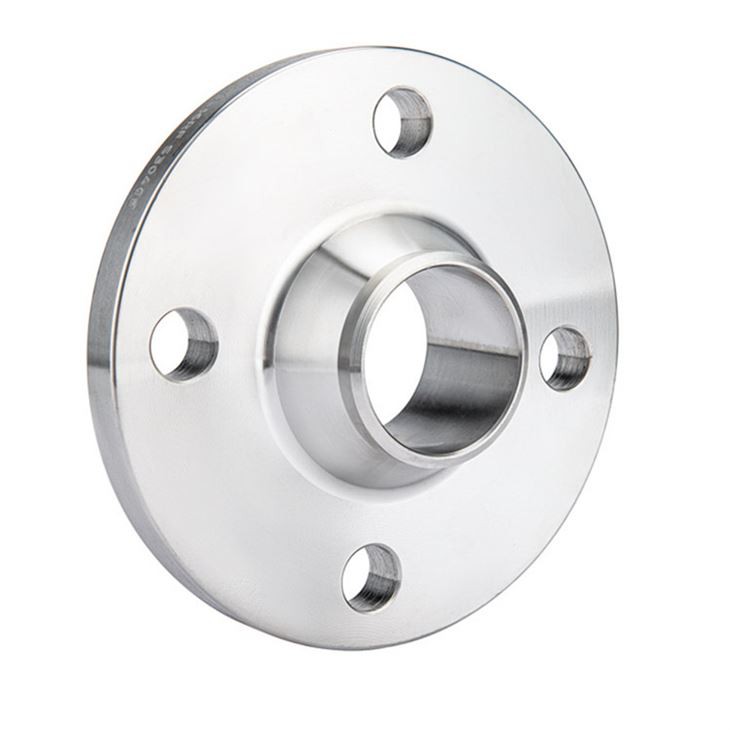
Welding Stainless Steel Pipe Flange, as an important component for fastening and connecting pipelines, plays a very important role in the industrial field. It is widely used and has a wide range of applications, with many unique characteristics. This product has strong adjustability. According to different needs and special requirements of pipelines, the connection methods of this product can be various, such as bolt connection, flange connection, and so on. This adjustability is very important as it can meet different pipeline connection requirements and bring convenience to industrial production.
Features
1. This product has good sealing performance. This is an undeniable feature, as good sealing performance during pipeline connection can prevent pipeline leakage and improve system safety.
2. This product has high load-bearing capacity. This characteristic is determined by its structure. It is a complex component composed of multiple bolts and connecting surfaces, which can withstand high vertical and horizontal loads. This performance can improve the stability and durability of the pipeline system, ensuring the long-term normal operation of the system.
3. Welding Stainless Steel Pipe Flange also has certain installation convenience. Due to the fact that the connection can be achieved through bolt connections or other means when using this product, installation is very simple. This feature is very suitable for managing large pipeline systems, which can greatly improve installation efficiency and speed, thereby saving work time and costs.
Specification
|
Product Name
|
welding stainless steel pipe flange
|
|
Size
|
1/2" to 48 "
|
|
Thickness
|
2mm - 50mm
|
|
Material
|
Stainless Steel
|
|
Surface Treatment
|
sandblasting,rolling sand |
|
Products are widely used in
|
Ship, electric power, metallurgy, natural gas, papermaking, environmental protection, water plants, refrigeration, heating, chemical industry, wind power, machinery, construction medicine, military industry, petroleum, marine oil, chemical and other pipeline system engineering.
|


Welding stainless steel pipe flanges requires careful preparation and execution to ensure a strong and leak-free joint. Here are the general steps for welding a stainless steel pipe flange:
Preparation: Clean the surface of the flange and pipe end that will be welded using a wire brush or grinder. Remove any rust, dirt, or contaminants that may affect the weld quality.
Alignment: Ensure that the flange and pipe end are properly aligned before welding. Use clamps or tack welds to hold them in place.
Tack Welding: Tack weld the flange and pipe end in several locations around the circumference of the joint. Check the alignment again before proceeding with the final weld.
Welding: Use the appropriate welding process for the type of stainless steel being welded, such as TIG or MIG welding. Weld the joint in sections, moving around the circumference of the joint until it is complete. Control the heat input to avoid distortion or burn-through of the material.
Post-Welding: Clean the weld area using a wire brush or grinder to remove any slag or rough edges. Check the weld for any cracks, porosity, or other defects that may require additional welding or repair.
Inspection: Perform a visual inspection of the weld and test for leaks using a hydrostatic test or other appropriate method.
By following these steps and ensuring proper welding techniques and equipment, a strong and durable stainless steel pipe flange joint can be achieved. It is important to consult the appropriate welding codes and standards for the specific application to ensure compliance and safety.


What is Welding Stainless Steel Pipe Flange
Welding stainless steel pipe flanges involves joining the flange to the end of a stainless steel pipe using welding techniques. This process typically involves aligning the flange with the pipe end, ensuring proper fit and alignment, and then welding them together to create a secure and leak-proof connection. Proper preparation of the mating surfaces, selection of appropriate welding parameters, and post-weld inspection are essential to ensure the integrity and quality of the welded joint.
Why Choose Us
Quality assurance
We work diligently to ensure that our products meet the highest standards of quality and performance. We follow industry trends, encourage feedback from our customers, and replace defective products, no questions asked.
Rich production experience
Our company has many years of production work experience. The concept of customer-oriented and win-win cooperation makes the company more mature and stronger.
After-sale service
Our terms of work have always been fixed within the work process and one can be assured about the guarantee of the work as we are there 24/7 business hours during the time your project is being worked is on.
Professional team
Our professional team collaborate and communicate effectively with one another, and are committed to delivering high-quality results. They are capable of handling complex challenges and projects that require their specialized expertise and experience.
Advantages of Welding Stainless Steel Pipe Flange
1. Enhanced strength
Welding stainless steel pipe flanges creates a strong and durable connection between the flange and the pipe, capable of withstanding high pressures, temperatures, and mechanical loads commonly encountered in industrial applications.
2. Leak resistance
Welded stainless steel pipe flanges provide a tight and leak-proof joint, minimizing the risk of fluid leakage or seepage, which is critical for maintaining the integrity and efficiency of piping systems, particularly in hazardous or sensitive environments.
3. Streamlined design
Welding stainless steel pipe flanges eliminates the need for additional fasteners or gaskets, resulting in a more compact and streamlined design that reduces the overall footprint of the piping system and simplifies installation and maintenance procedures.
4. Cost efficiency
While welding stainless steel pipe flanges may involve initial setup costs for welding equipment and skilled labor, it offers long-term cost savings by reducing the need for maintenance, replacement, or repairs associated with mechanical fasteners or gasketed connections.
5. Corrosion resistance
Stainless steel pipe flanges offer inherent corrosion resistance, and welding further enhances their resistance to corrosion by eliminating potential crevices or gaps where corrosion could initiate, ensuring long-term reliability and durability in corrosive environments.
6. Versatility
Welding stainless steel pipe flanges allows for flexibility in design and customization, enabling the fabrication of flange configurations tailored to specific project requirements, including non-standard sizes, shapes, or connection methods, to accommodate diverse piping layouts and operating conditions.

Can Stainless Steel Pipe Flanges Be Welded to Pipes of Different Materials?
Stainless steel pipe flanges can be welded to pipes of different materials, although careful consideration must be given to compatibility, material properties, and welding processes to ensure a strong and reliable joint. Welding dissimilar materials, such as stainless steel and carbon steel, requires appropriate filler materials and welding techniques to mitigate potential issues such as galvanic corrosion, differences in thermal expansion rates, and metallurgical incompatibilities. Proper surface preparation, joint design, and selection of compatible welding methods are essential to achieve a sound weld joint between stainless steel pipe flanges and pipes of different materials.
How Do You Prepare Stainless Steel Pipe Flanges For Welding?
Clean the surfaces of the flanges and pipes thoroughly to remove any dirt, grease, or contaminants that could affect weld quality. Next, carefully align the flanges and pipes to ensure proper fit and alignment, using alignment tools if necessary. Bevel the edges of the flanges and pipes to create a groove that allows for adequate penetration of the weld filler material. After beveling, chamfer the edges to remove any sharp corners and promote smoother weld transitions. Finally, inspect the prepared surfaces for any defects or imperfections that could compromise the integrity of the weld, and address any issues before proceeding with welding. Proper preparation of stainless steel pipe flanges is essential for achieving strong, leak-free welds and ensuring the integrity of the piping system.

What Welding Methods are Commonly Used For Welding Stainless Steel Pipe Flanges?
TIG Welding (tungsten inert gas)
TIG welding, also known as GTAW (Gas Tungsten Arc Welding), is a precise and versatile welding process suitable for welding stainless steel pipe flanges. It uses a non-consumable tungsten electrode and inert gas shielding to produce high-quality welds with excellent control over heat input and weld pool.
MIG welding (metal inert gas)
MIG welding, or GMAW (Gas Metal Arc Welding), is another commonly used method for welding stainless steel pipe flanges. It utilizes a consumable wire electrode and inert gas shielding to create welds quickly and efficiently. MIG welding is well-suited for high-volume production and is relatively easy to learn and use.
SMAW (shielded metal arc welding) or stick welding
SMAW, also known as manual metal arc welding or stick welding, is a versatile welding process suitable for welding stainless steel pipe flanges in various positions. It uses a flux-coated electrode and generates an arc between the electrode and the workpiece, producing welds with good penetration and strength.
FCAW (flux-cored arc welding)
FCAW is a semi-automatic or automatic welding process that uses a tubular electrode filled with flux to create welds. It can be used for welding stainless steel pipe flanges in outdoor or windy conditions where gas shielding may be difficult to maintain.
SAW (submerged arc welding)
SAW is an efficient welding process commonly used for welding thick-section stainless steel pipe flanges. It involves feeding a continuous wire electrode into the weld zone while a layer of granular flux covers the arc, preventing atmospheric contamination and producing high-quality welds with minimal spatter.
Orbital welding
Orbital welding is a specialized welding process that uses a rotating tungsten electrode to produce circumferential welds around stainless steel pipe flanges. It offers precise control over welding parameters and is often used for high-purity applications in industries such as pharmaceuticals and semiconductor manufacturing.
What Precautions Should Be Taken To Prevent Distortion During Welding of Stainless Steel Pipe Flanges?
Proper fit-up and alignment of the flanges and pipes are crucial to minimize stress and distortion during welding. Additionally, using appropriate welding techniques such as tack welding to secure the components in place before the final weld helps to reduce the likelihood of distortion. Controlling heat input by adjusting welding parameters and employing welding techniques that distribute heat evenly, such as backstepping, can also help mitigate distortion. Furthermore, employing suitable welding fixtures or clamps to support the workpiece and minimize movement during welding contributes to distortion prevention. Lastly, post-weld heat treatment techniques may be applied to relieve residual stresses and minimize distortion in the welded components.
Application of Welding Stainless Steel Pipe Flange
Water treatment
In water treatment facilities, welded stainless steel pipe flanges are used to connect pipes carrying treated water, chemicals, and slurry. They offer reliable connections that withstand the rigors of water treatment processes and maintain system efficiency.
Pharmaceutical manufacturing
Stainless steel pipe flanges are utilized in pharmaceutical manufacturing facilities for connecting pipes carrying sterile fluids, pharmaceutical ingredients, and process gases. Welded flanges maintain hygienic conditions and prevent contamination in pharmaceutical processes.
Food and beverage processing
In food and beverage processing plants, welded stainless steel pipe flanges are used to connect pipes carrying food products, beverages, and ingredients. They ensure sanitary conditions, comply with food safety regulations, and prevent product contamination.
Power generation
Stainless steel pipe flanges are used in power plants for connecting pipes carrying steam, water, and cooling fluids. Welded flanges provide leak-proof connections that withstand high temperatures and pressures in power generation processes.
Oil and gas industry
Welded stainless steel pipe flanges are used in oil refineries, petrochemical plants, and offshore drilling platforms for connecting pipelines carrying crude oil, natural gas, and petroleum products. They provide secure connections that withstand high pressures and corrosive environments.
Chemical processing
Stainless steel pipe flanges are employed in chemical processing plants for conveying corrosive chemicals, acids, and solvents. Welded flanges ensure leak-free connections, preventing contamination and ensuring the integrity of chemical processes.
Determining the appropriate welding parameters for stainless steel pipe flanges involves considering factors such as material thickness, welding method, joint design, and specific requirements of the application. Welding parameters typically include voltage, current, travel speed, electrode size, and shielding gas flow rate. These parameters are adjusted based on the type and thickness of the stainless steel, desired weld penetration, and welding position. Regular monitoring and adjustment of welding parameters ensure consistent and reliable welds in stainless steel pipe flange applications.
Can Stainless Steel Pipe Flanges be Welded in Confined Spaces?

Stainless steel pipe flanges can be welded in confined spaces with proper preparation and safety precautions. Welding in confined spaces requires careful consideration of accessibility, ventilation, and maneuverability to ensure the safety of the welder and the integrity of the weld. Specialized welding equipment, such as compact welding machines or welding torches with flexible heads, may be used to access tight or hard-to-reach spaces. Adequate ventilation and extraction systems should be implemented to remove welding fumes and ensure a safe working environment. Proper lighting and clearance around the welding area are essential for visibility and maneuverability.
How to Install Welding Stainless Steel Pipe Flange
Preparation
First, the welding area on the pipe and flange is cleaned thoroughly to remove any dirt, oil, or contaminants that could affect the weld quality. Proper preparation ensures optimal weld penetration and prevents defects.
Install
The pipe and flange are aligned and positioned correctly to ensure proper fit-up. Alignment is critical to achieving a strong and leak-free weld joint. Clamps or fixtures may be used to hold the components in place during welding.
Welding Method Selection
Common welding methods for stainless steel pipe flanges include TIG (Tungsten Inert Gas) welding, MIG (Metal Inert Gas) welding, and SMAW (Shielded Metal Arc Welding).
Welding
The welding process begins by establishing an arc between the welding electrode and the workpiece. The welder applies heat to the joint while feeding filler material (if necessary) to create a molten weld pool.
Weld passes
Multiple weld passes may be required, depending on the thickness of the material and the desired weld strength. Each pass should overlap slightly with the previous pass to ensure complete fusion and uniform penetration.
Post-weld treatment
After welding, the weld bead is inspected visually for defects such as cracks, porosity, or incomplete fusion. Any defects are repaired promptly using suitable techniques such as grinding or welding repair.
Inspection
Once the welding process is complete, the welded joint is inspected for quality and integrity using non-destructive testing methods such as visual inspection, dye penetrant testing, ultrasonic testing, or radiographic testing.
Finishing
Finally, the welded joint may be cleaned, deburred, and finished to remove any spatter or rough edges. Surface treatments such as pickling, passivation, or polishing may be applied to enhance corrosion resistance and improve aesthetics.
Material of Welding Stainless Steel Pipe Flange
The material used for welding stainless steel pipe flanges is typically stainless steel, chosen for its corrosion resistance, durability, and compatibility with various operating conditions. Common stainless steel grades used for flanges include 304, 316, and 316L, which offer excellent resistance to corrosion, high temperatures, and chemical exposure. Stainless steel flanges may undergo surface treatments or coatings to further enhance their corrosion resistance and longevity in demanding environments.
How Can Welding Defects in Stainless Steel Pipe Flanges Be Detected And Repaired?
Welding defects in stainless steel pipe flanges can be detected through various non-destructive testing methods such as visual inspection, dye penetrant testing, magnetic particle testing, ultrasonic testing, and radiographic testing. Visual inspection is the simplest method, allowing for the detection of surface irregularities or discontinuities. Dye penetrant and magnetic particle testing are used to identify surface cracks or flaws by applying dye or magnetic particles to the weld area. Ultrasonic and radiographic testing provide more detailed insights into internal defects such as porosity, inclusions, or lack of fusion. Once defects are identified, repairs can be carried out using techniques such as grinding, welding repair, or weld overlay to restore the integrity of the weld joint.

The components of welding stainless steel pipe flanges primarily include the stainless steel pipe and the flange itself. The stainless steel pipe serves as the conduit for fluid flow, while the flange provides a means of connecting the pipe to other components of the piping system, such as valves, fittings, or additional pipes. The flange typically consists of a flat, circular disc with bolt holes around its perimeter for securing it to a mating flange or pipe end. Welding the flange to the pipe involves aligning the two components and fusing them together using a suitable welding method, such as TIG welding or MIG welding, to create a strong and leak-proof joint.
Maintenance Tips for Welding Stainless Steel Pipe Flange
Regular inspection
Conduct routine visual inspections of the welded joints to detect any signs of corrosion, leaks, or damage. Inspect both the external and internal surfaces of the flanges and pipes for any irregularities.
Corrosion protection
Apply corrosion-resistant coatings or treatments to the welded joints to enhance their resistance to corrosive environments. This is particularly important in industries where the fluid being conveyed is corrosive.
Regular leak detection
Regularly check for leaks around the welded joints by visually inspecting for signs of fluid seepage or moisture accumulation. Address any leaks promptly to prevent further damage to the piping system.
Pressure testing
Periodically perform pressure testing on the piping system, including the welded joints, to ensure their integrity and leak-tightness under operating conditions. This helps identify potential weaknesses or vulnerabilities that may require attention.
Surface cleaning
Keep the surfaces of the welded joints clean and free from dirt, debris, or contaminants that could promote corrosion or compromise the integrity of the welds. Use mild detergents and non-abrasive cleaning tools for this purpose.
Proper handling
Handle the welded stainless steel pipe flanges with care during installation, maintenance, and handling to prevent mechanical damage or distortion of the welds. Avoid impacts or rough handling that could compromise their integrity.
Things to Note When Using Welding Stainless Steel Pipe Flange
Attention should be given to proper fit-up and alignment of the flanges and pipes to ensure a secure and leak-free joint. Choosing the appropriate welding method and parameters is crucial to achieve quality welds that meet the required standards and specifications. Adequate surface preparation and cleanliness are essential to prevent contamination and ensure optimal weld integrity. It's important to monitor the welding process closely and inspect the welded joints for any defects or irregularities. Selecting the right stainless steel grade and corrosion protection measures can enhance the longevity and performance of the flanges in corrosive environments.
The working principle of welding stainless steel pipe flanges involves joining the flange to the end of a stainless steel pipe through a fusion welding process. This process typically utilizes techniques such as TIG (Tungsten Inert Gas) welding, MIG (Metal Inert Gas) welding, or SMAW (Shielded Metal Arc Welding) to create a strong and permanent bond between the flange and the pipe. By generating an arc between the welding electrode and the workpiece, heat is applied to the joint, causing the base metal and filler material (if used) to melt and fuse together. As the weld cools, it solidifies, forming a continuous and leak-proof connection between the pipe and the flange. Proper fit-up, alignment, and welding parameters are essential to ensure the integrity and strength of the welded joint, enabling it to withstand the mechanical loads, pressures, and environmental conditions encountered in fluid handling systems.
What are The Differences Between Welding Stainless Steel Pipe Flanges And Using Mechanical Fasteners?
The primary differences between welding stainless steel pipe flanges and using mechanical fasteners lie in the method of joining and the resulting characteristics of the connection. Welding involves permanently fusing the flange to the pipe through the application of heat and filler material, creating a strong and leak-proof joint. Mechanical fasteners such as bolts and nuts secure the flange to the pipe by clamping them together, allowing for disassembly and reassembly if needed. While welding offers a more permanent and robust connection, mechanical fasteners provide versatility and ease of maintenance, allowing for easier adjustments or replacements of components.

The factory area is 10,000+㎡, with 60+ sets of production equipment and 70+ sets of supporting molds. Our factory has a standing inventory of 800+ tons, and the annual production capacity can reach 5,000+ tons. We support OEM/ODM, processing according to the drawings, and also provide surface treatment such as sandblasting, sand rolling, mirror surface etc.

FAQ
Q: What is a stainless steel pipe flange?
Q: What types of stainless steel pipe flanges are commonly welded?
Q: What welding methods are used to weld stainless steel pipe flanges?
Q: What are the advantages of welding stainless steel pipe flanges?
Q: What factors should be considered before welding stainless steel pipe flanges?
Q: How is joint preparation carried out before welding stainless steel pipe flanges?
Q: What precautions should be taken to prevent contamination during welding?
Q: What welding parameters are critical for welding stainless steel pipe flanges?
Q: How can defects in welded stainless steel pipe flanges be detected and repaired?
Q: What are the considerations for selecting filler materials for welding stainless steel pipe flanges?
Q: Are there special welding techniques for welding stainless steel pipe flanges in corrosive environments?
Q: What precautions should be taken to prevent intergranular corrosion in welded stainless steel pipe flanges?
Q: How can the integrity of welded stainless steel pipe flanges be tested?
Q: What are the considerations for inspecting welded stainless steel pipe flanges?
Q: Can stainless steel pipe flanges be welded to dissimilar materials?
Q: How can welding stainless steel pipe flanges affect the corrosion resistance of the welded joint?
Q: What are the considerations for welding stainless steel pipe flanges in high-temperature applications?
Q: What are the best practices for welding stainless steel pipe flanges in sanitary applications?
Q: Can stainless steel pipe flanges be welded in confined spaces or overhead positions?
Q: What are the environmental and safety considerations associated with welding stainless steel pipe flanges?
Hot Tags: welding stainless steel pipe flange, China welding stainless steel pipe flange manufacturers, factory, stainless steel welding finish flange, stainless steel specification flange, stainless steel labeling flange, stainless steel identification flange, stainless steel slip on flange, stainless steel packaging flange