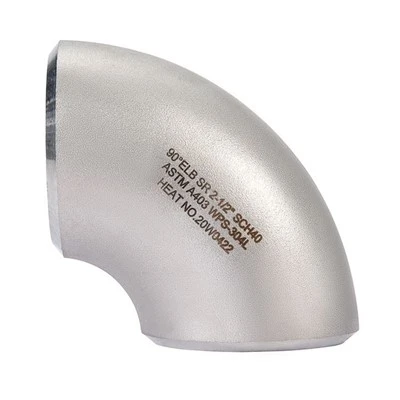
The 316L Eccentric Reducing Elbow is a butt-weld pipe fitting that changes pipe direction while connecting two different pipe sizes. Its two ends have offset centerlines, creating an eccentric transition rather than the aligned centerline of a concentric reducing elbow.
316L stainless steel combines low carbon content with chromium, nickel and molybdenum. The fitting is used where the specified piping material and eccentric geometry match the process requirements. Key ordering details include end sizes, wall thickness, elbow angle, center-to-end dimensions and eccentric orientation.
Product Advantages
Controlled Eccentric Offset
The offset between the two ends establishes a defined relationship between the connected pipe centerlines. This allows the fitting orientation to follow the required piping elevation and layout.
316L Stainless Steel
316L is a low-carbon austenitic stainless steel grade. Typical composition limits include 16.0–18.0% chromium, 10.0–14.0% nickel, 2.0–3.0% molybdenum and a maximum carbon content of 0.030%.
Butt-Weld Ends
Butt-weld ends provide a direct pipe connection. End diameter, wall thickness and bevel geometry can be matched to the specified pipe and welding requirements.
Key Specifications
|
Item |
Specification |
|
Product Type |
Eccentric Reducing Elbow |
|
Material Grade |
316L Stainless Steel |
|
UNS Designation |
S31603 |
|
Elbow Angle |
45° / 90° |
|
Common Size Range |
1/2"–12" |
|
Metric Size Range |
DN15–DN300 |
|
Connection |
Butt Weld |
|
Carbon |
≤ 0.030% |
|
Chromium |
16.0–18.0% |
|
Nickel |
10.0–14.0% |
|
Molybdenum |
2.0–3.0% |
|
Wall Thickness |
Schedule / drawing specified |
|
Surface Finish |
Pickled / polished / specified |
|
Inspection |
Visual / dimensional / material verification |
Size & Configuration Selection
End Sizes
State both connection sizes, such as 6" × 4". This identifies the large and small ends and provides a clear basis for dimensional review.
Eccentric Direction
Specify the required orientation when the offset affects pipe elevation. Flat-side-up and flat-side-down configurations create different installation positions and should follow the piping drawing.
Elbow Angle
A 90° elbow provides a full directional change. A 45° configuration provides a smaller directional change within the piping route.
Manufacturing Process
Material Preparation
316L material is identified by grade and heat information before production. Material records are matched with the applicable purchase requirements.
Forming
The fitting body is formed to establish the required elbow angle and eccentric transition between the two pipe sizes.
End Preparation
Both ends are processed to the specified outside diameter, wall thickness and weld-end geometry. End dimensions are checked before final inspection.
Surface Finishing
Pickling, polishing or another specified finish can be applied according to the purchase specification and service requirements.
Dimensional Control
End Diameter
Large-end and small-end dimensions are measured against the specified pipe sizes and dimensional requirements.
Wall Thickness
Wall thickness is checked at defined inspection locations to verify conformity with the required fitting specification.
Center-to-End
Center-to-end dimensions are controlled against the approved drawing or applicable dimensional standard.
Eccentric Orientation
The offset direction is checked together with the end dimensions to maintain the required installation position.
Material & Inspection
Material Identification
316L grade and heat information are checked against the material documentation. Chemical composition can be verified against the specified grade.
Visual Inspection
The body surface, weld ends and finished geometry are visually examined before release.
Dimensional Inspection
Inspection covers critical dimensions such as end diameter, wall thickness, center-to-end length, angle and eccentric orientation.
Quality Documents
Material certificates, dimensional inspection records and other agreed documents can be supplied according to the purchase requirements.
Typical Applications
Chemical Processing
Used in process piping where 316L stainless steel and an eccentric reducing configuration match the specified service conditions.
Water Treatment
Applied in stainless steel fluid systems where different pipe sizes must be connected within a defined piping layout.
Food Processing
Used for process piping where the selected material, surface condition and connection requirements meet the applicable project specification.
Pharmaceutical Processing
Applied in specified stainless steel process systems where material identification, dimensional control and surface requirements are part of the purchase specification.
Procurement Checkpoints
Material
Confirm 316L grade, material specification and required certification.
Dimensions
Provide large-end size, small-end size, wall thickness or schedule, elbow angle and center-to-end dimensions.
Orientation
State the eccentric direction when flat-side position affects installation or pipe elevation.
Connection
Confirm butt-weld end dimensions and bevel requirements.
Inspection
Define material verification, dimensional inspection and required quality documents before production.
Why Choose 316L Eccentric Reducing Elbow
Selection depends on the relationship between material grade, pipe sizes and eccentric orientation.
The 316L grade must match the specified service requirements. The large and small ends must correspond with the connected pipe dimensions. The eccentric direction must follow the piping drawing so the fitting maintains the intended installation position.
For project purchasing, a dimensional drawing together with size, wall thickness, angle and orientation provides a clear basis for technical review and quotation.
FAQ
Hot Tags: 316l eccentric reducing elbow, China 316l eccentric reducing elbow manufacturers, factory, elbow sus304, stainless steel elbow for piping system, stainless steel elbow gb, stainless steel elbow in bunker, stainless steel elbow supplier, welded elbow fittings