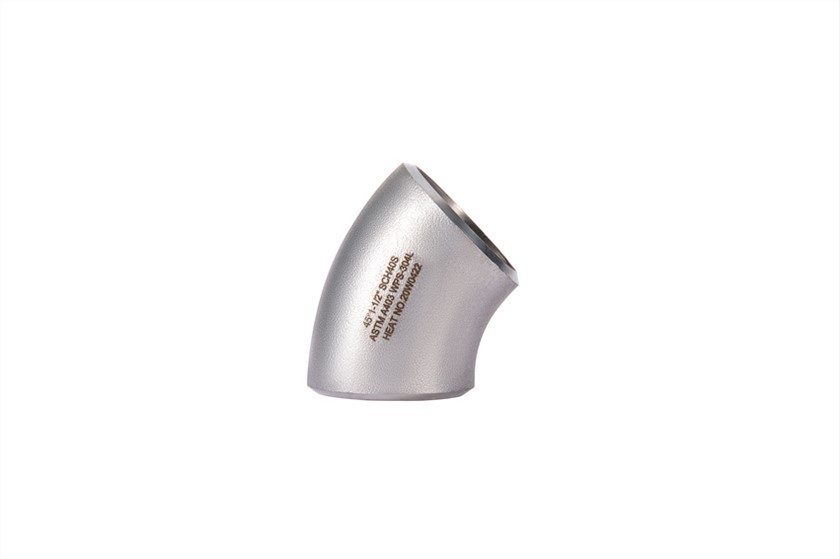
A 90 degree stainless steel elbow is a plumbing fitting designed to change the direction of a pipe by 90 degrees. The most common types are the long radius (LR) and short radius (SR) elbows, typically manufactured from steel, brass, chrome alloy, stainless steel, or plastic materials. It is commonly used in residential and commercial applications. Its construction can vary depending on what material it is made from, its size, and its pressure rating.
Benefits of 90 Degree Stainless Steel Elbow
Corrosion Resistance
Stainless steel is inherently resistant to corrosion, making 90 degree stainless steel elbow ideal for applications where exposure to moisture, chemicals, or corrosive substances is prevalent. This resistance ensures longevity and reliability, even in demanding environments such as industrial facilities or coastal regions.
Strength and Durability
Stainless steel is renowned for its exceptional strength and durability, making it an ideal material for elbow pipe fittings. These fittings can withstand high pressure and temperature conditions without succumbing to deformation or structural failure, ensuring long-term performance and safety.
Aesthetic Appeal
Beyond their functional advantages, 90 degree stainless steel elbow offer aesthetic appeal, making them a popular choice for both residential and commercial plumbing applications. The sleek and polished finish of stainless steel adds a touch of sophistication to any plumbing system, enhancing the overall visual appeal of the space.


Why Choose Us
Cutting-edge technology
Our team is committed to delivering high-quality services to our clients. We use the latest technologies and tools to ensure that our services exceed your expectations.
Experience and expertise
Our company has been in business for many years and has amassed significant expertise and experience to provide quality services to our clients.
Quality
The company strength is abundant, the heavy credit, keep the contract, guarantee product quality, product variety is complete, the price is reasonable, with many varieties management characteristic and the meager profit but high turnover principle, has won the trust of customers.
What is a 45-degree elbow?
A 45-degree elbow is designed to connect two pipes at a 45-degree angle, allowing for a more gradual change in direction.
Characteristics
Smooth flow: The gradual curve offers a smoother flow with minimal turbulence.
Reduced pressure loss: Helps maintain pressure levels within the system.
Minimal space requirement: Requires less space for installation compared to sharper angles.
Applications
Hvac systems: Ideal for air handling and ventilation, ensuring efficient airflow.
Plumbing: Used in water supply lines for smooth transitions.
Chemical processing: Suitable for systems requiring gentle direction changes.
The 45-degree elbow is often preferred in systems where maintaining flow efficiency is critical, and the gentle bend helps reduce wear and tear on the piping system.
What is a 90 degree stainless steel elbow?
A 90 degree stainless steel elbow is designed to connect two pipes at a right angle, allowing for a more abrupt change in direction.
Characteristics
Right angle connection: Offers a sharp turn, redirecting flow at a right angle.
Increased pressure drop: This may cause more turbulence and pressure loss.
Space efficient: Allows for compact installations where space is limited.
Applications:
Plumbing and drainage: Commonly used in wastewater systems for directional changes.
Industrial piping: Suitable for redirecting flow in compact systems.
Oil and gas: Used in high-pressure systems where space constraints exist.
The 90 degree stainless steel elbow is often chosen for applications where space is a concern, and the system can handle the increased pressure drop and turbulence.
Differences between 45-degree and 90 degree stainless steel elbow
While both elbows are used to change the direction of flow in a piping system, there are several key differences between them:
Angle of bend
45-degree elbow: Connects two pipes at a 45-degree angle, offering a more gradual change in direction.
90 degree stainless steel elbow: Connects two pipes at a right angle (90 degrees), providing a more abrupt change in direction.
Flow characteristics
45-degree elbow: Offers smoother flow with less turbulence and pressure drop. It is often used in systems where maintaining flow efficiency is essential.
90 degree stainless steel elbow: Causes more turbulence and pressure loss, which may be acceptable in systems with adequate pressure handling capacity.
Space requirements
45-degree elbow: Requires more space for installation due to the gentle curve.
90 degree stainless steel elbow: Space-efficient and suitable for compact installations where space is limited.
Applications
45-degree elbow: Ideal for hvac, chemical processing, and systems requiring smooth flow transitions.
90 degree stainless steel elbow: Commonly used in plumbing, drainage, and industrial piping with space constraints.
Advantages of using 45-degree and 90 degree stainless steel elbows
Both types of elbows offer unique advantages that cater to specific needs and applications:
45-degree elbow advantages
Smooth flow: Ensures minimal turbulence, maintaining flow efficiency.
Reduced wear and tear: Gentle curves reduce stress on the piping system.
Versatility: Suitable for various applications, including hvac and chemical processing.
90 degree stainless steel elbow advantages
Compact design: Ideal for space-constrained installations.
Cost-effective: Often more affordable due to simpler design.
Widespread use: Commonly used in residential and industrial plumbing systems.
Choosing the right elbow for your application
Selecting the appropriate elbow for your piping system involves understanding the specific requirements of your application, including:
Flow characteristics: Consider the impact of turbulence and pressure drop.
Space constraints: Evaluate the available space for installation.
Material compatibility: Choose the right material for your environment and fluid type.
Industry standards: Ensure compliance with industry regulations and standards.
How to Choose the Right 90 Degree Stainless Steel Elbow for Food Processing Industries

Material Grade: The material grade of stainless steel is vital as it determines the resistance to corrosion, durability, and suitability for food processing environments. The most recommended material grade for food processing industries is Type 316 stainless steel, also known as 316 SS. This grade offers excellent corrosion resistance and is resistant to both organic and inorganic chemicals commonly found in food processing.
Surface Finish: The surface finish of 90 degree stainless steel elbows is essential for the food processing industry. A smooth and polished surface finish minimizes the adhesion of bacteria, dirt, and other contaminants, making it easier to clean and maintain hygiene. A typical requirement for food processing industries is a surface finish of 32 microinches or better.
Dimensions: The dimensions of the 90 degree stainless steel elbow should be compatible with the existing piping system. Consider the angle of the elbow, commonly available in 45 degrees and 90 degrees, depending on the specific needs of your food processing system. Additionally, ensure that the elbow has the appropriate diameter to match the rest of the piping system.
Welding: 90 degree stainless steel elbows are usually welded to the piping system. It is crucial to consider the welding method used and ensure that it complies with sanitary welding standards. Welding should be done using a TIG (Tungsten Inert Gas) welding process to ensure clean and smooth welds, avoiding any crevices or voids that could harbor bacteria or other contaminants.
Certifications and Compliance: When choosing a 90 degree stainless steel elbow for food processing, ensure that it meets relevant industry standards and certifications. Look for certifications such as NSF/ANSI standard 51 for food equipment materials, NSF/ANSI standard 61 for materials used in contact with drinking water, and FDA (Food and Drug Administration) compliance for materials used in food processing.
Cleanability and Maintenance: The ease of cleaning and maintenance is a crucial factor for the food processing industry. Choose a 90 degree stainless steel elbow with minimal crevices, as this reduces the chances of bacterial growth and makes it easier to clean. Additionally, consider the availability of cleaning systems such as CIP (Clean-in-Place) or SIP (Steam-in-Place) for efficient and effective cleaning.
Supplier Reputation and Support: Selecting a reputable supplier is essential to ensure quality products and reliable customer support. Look for suppliers with experience in supplying 90 degree stainless steel elbows for the food processing industry and those who understand the unique requirements and challenges of food processing environments.
1. long-term storage of 90 degree stainless steel elbow, should be checked regularly, often on the exposed surface to be clean, remove the dirt, cleanly stored in the indoor dry place, is strictly prohibited or open storage. Often keep the 90 degree stainless steel elbows dry and breathe, keep the fixtures clean and clean, and store them in accordance with the exact storage method.
2. The installation, the 90 degree stainless steel elbow can be connected directly by the way in the pipeline, according to the location of the installation. Under normal circumstances, can be installed in any position on the pipeline, but need to facilitate the operation of the inspection, pay attention to cut off the 90 degree stainless steel elbow media flow should be below the vertical valve flap, 90 degree stainless steel elbow can only be installed horizontally. 90 degree stainless steel elbow in the installation should pay attention to sealing, to prevent the phenomenon of thrown, affecting the normal operation of the pipeline.
3. 90 degree stainless steel elbow ball valve, globe valve, gate valve use, only for full open or closed, do not agree to do with the regulation of flow, so as to avoid the erosion of the sealing surface to accelerate wear. Gate valve and the upper thread cut-off valve with inverted sealing device, hand wheel to the top position of the tightening, you can prevent the media from the filler leakage.
4. 90 degree stainless steel elbow application hand wheel, do not use the lever or other tools, so as not to damage the valve. Handwheel turns clockwise for rotation, and vice versa. When you use justice, to ensure accurate use of methods and means.
5. 90 degree stainless steel elbow valve packing gland bolts should be tightened evenly, should not be pressed into a crooked state, so as not to bump the stem movement or cause leakage.
6. 90 degree stainless steel elbow in the use of the process, should always keep clean, the transmission thread must be lubricated on time, found fault, should immediately stop using, to identify the reasons to clear the fault.
The Processing Method Of 90 Degree Stainless Steel Elbow Is As Follows
Forging method: The end of the pipe or a section is punched by a swaging machine to reduce the outer diameter. The common forging machine has a rotary type, a link type and a roller type.
Rolling method: Generally, the mandrel is not used, and it is suitable for the inner edge of the thick-walled tube. The core is placed in the tube, and the outer circumference is pressed by a roller for round edge processing.
Stamping method: The pipe end is expanded to the required size and shape with a tapered core on the punching machine.
Bending forming method: There are three methods that are more commonly used. One method is called stretching method, the other method is called pressing method, the third method is roller method, there are 3-4 rollers, two fixed rollers, one adjusting roller, and adjustment. With the fixed roll distance, the finished pipe is curved.
Inflating method: One is to place rubber in the tube, and the upper part is compressed by a punch to make the tube convex and convex; the other method is to form a hydraulic bulge, fill the middle of the tube with liquid, and the liquid pressure drums the tube into the required The shape, the bulk of the production of bellows is used in this way.
Our Factory
Zhejiang Mingli Management Co., Ltd. was founded in 1994 with a registered capital of 50 million. We have more than 30 years of experience in production and processing of stainless steel pipelines. The factory area is 10,000+㎡, with 60+ sets of production equipment and 70+ sets of supporting molds. Our factory has a standing inventory of 800+ tons, and the annual production capacity can reach 5,000+ tons. We support OEM/ODM, processing according to the drawings, and also provide surface treatment such as sandblasting, sand rolling, mirror surface etc.


Our Certificates
Get certificate: ISO9001 certification, (TS) special equipment production license, DAS certification


Asked Questions
Hot Tags: 90 degree stainless steel elbow, China 90 degree stainless steel elbow manufacturers, factory, 316 stainless steel fitting, 120mm to 100mm fitting, stainless elbow products, cpvc pipe fitting, 304 stainless steel threaded fitting, fitting for bend pipe