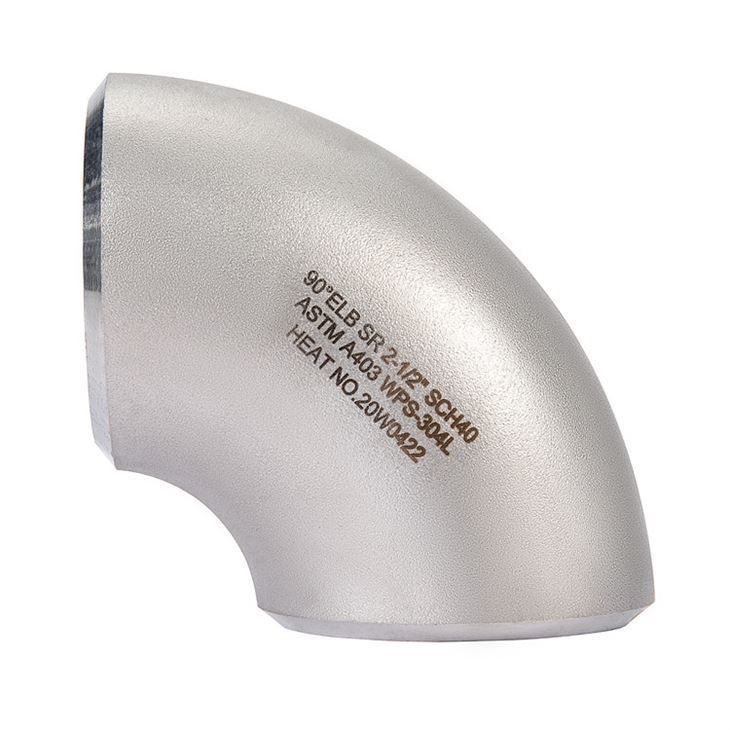
specifications of Stainless steel elbow
|
ANSI Specification |
ANSI B16.9 |
|
ASME Specification |
ASME SA-403 |
|
ASMT Specification |
ASTM A-403 WPW |
|
Bending Angle |
45 Degree, 90 Degree, 180 Degree, etc. |
|
Size |
1/2 inch-10 inch |
|
Material |
Stainless Steel 304/316/321/347 |
|
Schedule |
Sch5s/Sch10s/Sch5s40s/Sch5s80s |
|
Elbow Type |
Long Radius, Short Radius, Straight |
|
Minimum Order Quantity |
1 Piece |


What Can We Do?
Main Products: We specialize in producing elbows, pipes, tees, stub ends, reducing pipes, pipe caps, flanges, etc.
Production Standards: Our pipeline products are produced in accordance with US standards ASTM A733/A865, German standard DIN2982/DIN2986, British Standard BS EN10241, and Japan standard JISB2302. They are sold to Israel, Germany, Italy, South Korea, the United States, the Middle East, Canada, France, and other countries and are well received.
Materials For Elbows: Alloy Steel, Stainless Steel, Heat-Resistant Steel, Duplex Stainless Steel.
High Quality Products: We are specilized in Stainless Steel Elbow manufacturing more than 30 years and owns 20 professional technical R & D personnel and skilled operators. Moreover, we have multiple sets of advanced production and testing equipment, which assures high quality of our products.
Products Description
Stainless Steel Elbow is a pipe fitting installed between two sections of pipelines. In the pipe system, it is mainly used to change the pipe direction, angle, or connect pipes of different directions. It can turn the pipeline to 30 degrees, 45 degrees, 90 degrees, 180 degrees, etc. to adapt to different pipeline layouts. Users can connect pipelines by welding, threads, flanges, etc. At the same time, good corrosion resistance, high-temperature resistance, and pressure resistance of stainless steel make the product be used in industries such as chemical, natural gas, pharmaceutical, food processing, etc.


Classification of Stainless Steel Elbow
- Production Process: welding elbow, stamping elbow, casting elbow, etc.
- Material: different kinds of stainless steel (304, 316, 310, 321, 301...)
- Production Method: Our elbows can be made by pushing, pressing, forging, casting, etc.
- Manufacturing Standards: GB/T, Electric Standard, Water Standard, Japanese Standard (JIS), German Standard (DIN), American Standard (ANSI), etc.
- Curvature Diameter: It can be divided into long-radius elbows and short-radius elbows. Long radius elbow refers to the outer diameter with a curvature radius of 1.5 times, that is, R = 1.5D. The short radius elbow refers to its curvature radius equal to the outer diameter of the pipe, that is, R = 1.0D.
- Outer Diameter: 304 stainless steel elbow can also be divided into equal-diameter elbows and non-equal-diameter elbows. The former ones are used to connect the pipelines with the same outer diameter, and the latter ones are used to connect the pipelines of different outer diameters.
- Elbow Direction Angle: 45 degrees, 90 degrees, 180 degrees, etc.
- Method of Connection: direct welding connection(most commonly used), flange connection, hot melt connection, electric melt connection, thread connection, inheritance connection, etc.

2520 310s Stainless Steel Elbow
2520 and 310S are different grades of stainless steel commonly used in various industries. Both grades offer excellent corrosion resistance and high-temperature strength, making them suitable for applications involving harsh environments. It is important to consider the application when choose 2520 or 310S stainless steel for an elbow.

Steel 90 degree elbow are designed for pharmaceutical applications and are used to connect stainless steel pipes that need to be turned. Therefore, 316 stainless steel is always selected for this kind elbow. These accessories need to extend the tangent to adapt to a large number of rail welding heads used in the automatic welding program in pharmaceutical accessories.

Stainless Steel Tubing Elbows are one of the commonly used pipeline connection components in construction, chemical, pharmaceutical, food, shipbuilding. They have high strength and pressure resistance, and can use under high temperature and high pressure conditions.
Types of stainless steel for elbow
As we all know, stainless steel has excellent corrosion resistance, heat resistance, and high pressure resistance, so stainless steel elbows are often used for special purposes. We offer different stainless steel pipe elbows:
304 and 316L are the most commonly used stainless steel grades, and they are both high-chromium austenitic grades.
Other grades such as 321/321H and 347/347H are also available - this type of stainless steel is very stable and has good corrosion resistance, making it suitable for elbows used at high temperatures.
Special alloys such as 904L and 2205 are also commonly used in elbows - 904L stainless steel has excellent corrosion resistance, especially in strong acid, strong alkali, and salt water environments.

The application case

Oil and gas industry:
In the field of oil and natural gas transportation, stainless steel elbows are generally used to connect pipes and valves, pumps, oil wells, storage tanks, and other equipment. It can efficiently and stably completes the transportation of liquids and gases.

Chemical industry
Chemical plants involve many dangerous goods, such as corrosive compounds, high-temperature gases, and liquids. The installation of elbows can make pipelines safer and more reliable. At the same time, the elbow can bend the pipe to the required angle, making chemical production more convenient and safer.
FAQ
Q: How to choose the most suitable stainless steel elbow?
Q: How many types of elbow radius are there?
Q: What is the use of long radius and short radius elbow?
Q: What is the difference between 90 degree and 45 degree elbow?
Q: How to maintain the stainless steel elbows?
After installing the stainless steel elbow on a specific pipe, the elbow must be sealed by welding and other methods to prevent liquid leakage and other problems. Regularly inspect elbows for any damage or corrosion and have them repaired or replaced immediately.
Store unused stainless steel elbows neatly in a ventilated and dry indoor area, check them regularly, and clean their outer surfaces to keep them in good condition.
Q: How are steel elbows made?
Q: What is usage of Stainless Steel Elbow?
Chemical industry: Chemical plants involve many dangerous goods, such as corrosive compounds, high-temperature gases, and liquids. The installation of elbows can make pipelines safer and more reliable. At the same time, the elbow can bend the pipe to the required angle, making chemical production more convenient and safer.
Food industry: Stainless steel elbows have good corrosion resistance, will not rot and rust, and can be used to connect tanks, containers, conveyor belts, etc. The smooth appearance and non-toxic materials allow it to be used in food processing and storage processes with high hygiene requirements. It can prevent food contamination and prevent the growth of microorganisms.
Oil and gas industry: In the field of oil and natural gas transportation, stainless steel elbows are generally used to connect pipes and valves, pumps, oil wells, storage tanks, and other equipment. It can efficiently and stably completes the transportation of liquids and gases.
Biopharmaceutical industry: Pipelines in the biopharmaceutical field must have good corrosion resistance and must be non-toxic, odorless, and able to withstand extreme environments such as high temperature, high pressure, and strong acid. Stainless steel elbow pipes exactly meet this requirement and can be used to transport pharmaceuticals and other chemical substances.
Construction industry: Our elbows can be used to connect water supply and drainage pipes, which are very common in air conditioning, heating, and ventilation systems.
Sewage treatment industry: Stainless steel elbows can be used to connect sewage treatment equipment, such as reactors, filters, and transportation pipelines. Good corrosion resistance allows it to contact various liquids and remain stable.
Q: Which type of Stainless Steel Material can I choose?
As we all know, stainless steel has excellent corrosion resistance, heat resistance, and high pressure resistance, so stainless steel elbows are often used for special purposes. We offer different stainless steel pipe elbows:
304 and 316L are the most commonly used stainless steel grades, and they are both high-chromium austenitic grades. Austenitic stainless steel is a relatively special stainless steel, containing more than 18% chromium and more than 8% nickel, as well as other trace elements, such as molybdenum, titanium, etc., so it can make the elbow have good corrosion resistance and meet most usage requirements.
Other grades such as 321/321H and 347/347H are also available - this type of stainless steel is very stable and has good corrosion resistance, making it suitable for elbows used at high temperatures. 321 stainless steel has more titanium elements, and 347 stainless steel has more niobium elements. Titanium has less impact on welding performance, so 321 stainless steel is easier to weld and process than 347 stainless steel.
Special alloys such as 904L and 2205 are also commonly used in elbows - 904L stainless steel has excellent corrosion resistance, especially in strong acid, strong alkali, and salt water environments. 2205 stainless steel, also known as duplex stainless steel, is known for its excellent corrosion resistance, high yield strength, and wide range of applications. It is stable under both high and low-temperature conditions, but its corrosion resistance is not as good as 904L
Hot Tags: stainless steel elbow, China stainless steel elbow manufacturers, factory, stainless steel elbow buy, elbow pipe steel, stainless welding elbows, stainless steel elbow in high pressure environment, stainless steel elbow in clean room environment, stainless steel 90 degree elbow